Document Summary
The Document Summary tool converts dense medical records into clear, attorney-ready narratives. It highlights key diagnoses, treatment milestones... read more
A Ramos Law innovation. Engineering & data science methods developed by the Medical & Data Science Division using more than a decade of Ramos Law case experience and public court/settlement databases to support case review, valuation, and patient recovery considerations.
Explore the LxIntel Suite Request Internal Demo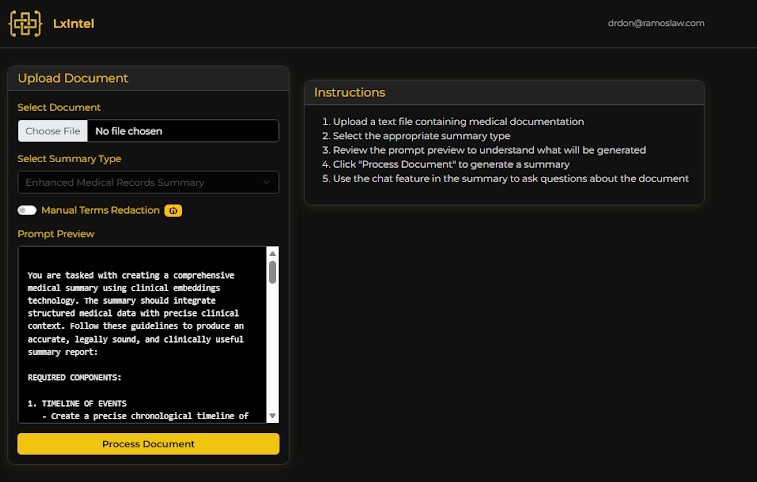
LxIntel is a Ramos Law innovation built by the Medical & Data Science Division. The suite blends more than a decade of Ramos Law’s case experience with models trained on public court and settlement databases. These tools help attorneys understand medical facts, damages, valuation patterns, and recovery considerations more quickly and consistently

The Document Summary tool converts dense medical records into clear, attorney-ready narratives. It highlights key diagnoses, treatment milestones... read more

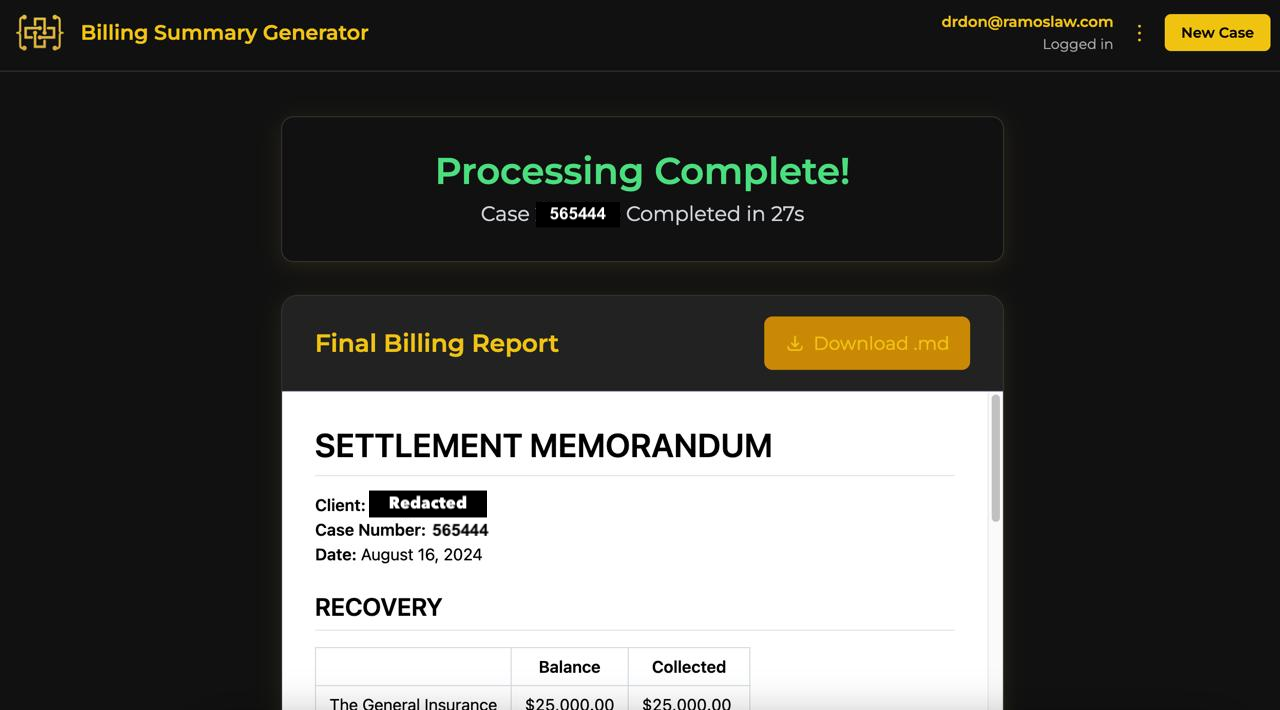
The Demand Optimizer tool organizes charges, CPT codes, and balances into structured, easy-to-read outputs. It helps attorneys and staff quickly see total billed care...read more

The VICP Attorney Fee Calculator applies Vaccine Injury Compensation Program guidelines to time and cost entries...read more

The BriefWriter Prototype assists with drafting sections of litigation documents, including responses to dispositive motions such as motions for summary judgment...read more

The Case Value Estimator uses structured case features—such as medical bills, policy limits, injury severity, and treatment duration—to generate data-informed...read more

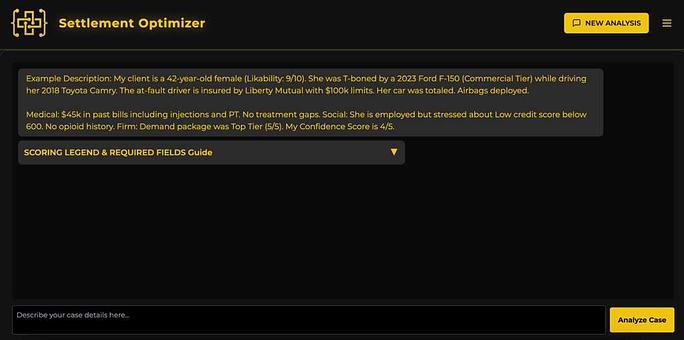
The Settlement Optimization tool combines a brief natural-language case description with key numeric inputs (bills, policy limits, time off work, injury severity...read more

Upload a demand and supporting records such as medical summaries or billing summaries. LxIntel cross-checks the demand against the underlying documents to verify accuracy,...read more

The Redactor tool automatically identifies and removes PHI and other sensitive fields from medical records before analysis or sharing. It preserves document...read more

The Injury Intelligence: Vision tool allows users to upload an image of the crash and provides fast, AI-assisted injury evaluation by analyzing the reported mechanism...read more

The Vehicle Loss Analyzer uses IIHS and HLDI insurance loss profile data by vehicle make, model, and class to summarize injury-claim and repair-loss patterns relative to the average passenger vehicle. It is designed to support negotiation framing, demand drafting, and countering “minor impact” narratives by providing clear, data-informed context, not to establish causation, fault, or case-specific outcomes. ...read more
LxIntel blends three primary sources of insight:
These inputs help the Medical & Data Science Division design tools that assist attorneys in understanding likely settlement ranges, injury trajectories, and recovery-related considerations—while always keeping final judgment in human hands.
These short videos feature Dr. Don discussing Ramos Law’s use of AI, Optimization modeling, crash-injury analytics, and data-driven legal strategy. This work forms the foundation of LxIntel, our internal legal intelligence platform.

A podcast conversation with Dr. Don on how legal outcomes and settlement ranges can be informed by structured data and machine-learning approaches.

A segment highlighting Ramos Law’s innovative use of data mining, crash analysis, and modeling to support better settlement and recovery outcomes.
Topics Dr. Cooper Discusses in AI & Legal Innovation
“AI offers incredible potential for law and medicine—but only when used responsibly, ethically, and under human supervision. Our goal at Ramos Law is to harness these tools to improve case outcomes, accelerate treatment decisions, and support the people we serve.” — Dr. Don Cooper
LxIntel is being explored as a structured way to support partner and referral firms through collaboration, case-sharing, and controlled licensing models directed by Ramos Law.

LxIntel was developed by the Ramos Law Medical & Data Science Division to solve real problems our
attorneys face every day: dense medical records, complex billing, and the need for fast, defensible case
evaluations.
Over years of practice, Ramos Law has built deep knowledge in medical-injury and VICP matters. LxIntel
integrates that experience by mining patterns from historical case outcomes and public databases of
court decisions and reported settlements. This approach helps guide internal decision-making while
preserving full attorney oversight.
LxIntel is not a replacement for attorney judgment — it is an assistive layer that accelerates case understanding while keeping humans in control.
All workflows are designed as “assistive, not autonomous,” with PHI-aware handling and human-in-the-loop review.

LxIntel is built on the principle that licensed attorneys remain the supervised mind behind every decision. AI helps with analysis and drafting, but Ramos Law lawyers are responsible for verifying authorities, reviewing outputs, and making final strategic and ethical judgments.

All LxIntel outputs are treated as drafts or starting points. Ramos Law attorneys are responsible for reviewing, editing, and approving any work product before it is used in a case or filed with a court.

LxIntel is used with the understanding that authorities, quotations, and legal propositions must be checked against primary sources in traditional research tools. The system is explicitly not a substitute for shepardizing or verifying case law.

Workflows are designed for sensitive medical and case data. Data use is restricted to internal, controlled environments, and we avoid training general-purpose models on identifiable client or patient information.

LxIntel is used in alignment with emerging bar guidance on generative AI, including duties of competence, confidentiality, supervision, candor, and reasonable fees. Internal policies emphasize verification of authorities and human review before filing.

Time spent using LxIntel is treated as part of reasonable and efficient representation, not an excuse to duplicate work. Attorneys and staff receive internal training on proper use, limitations, and documentation practices.

LxIntel provides analysis and draft language, but it does not give independent legal advice. Ramos Law attorneys remain fully responsible for legal strategy, client counseling, and all signed work product.
We practice a zero retention protocol so no personal information (PHI) is compromised. All documents that use cloud AI providers are first locally redacted before sending to LLM.

Turn days of manual review into minutes by surfacing the most important medical facts, billing data, and value drivers for each case.

Standardized summaries, fee calculations, and valuation frameworks support internal QA, training, and clear communication with adjusters and co-counsel.

LxIntel can be used to support referral relationships or partner firms, offering value-added tools in exchange for high-quality cases or collaboration.

LxIntel is built as PHI-aware, assistive AI with mandatory human review at every step and a strict zero-retention policy—ensuring sensitive medical and case data is never stored, reused, or used to train models.
LxIntel is ready for internal evaluation by Ramos Law leadership and selected teams, with a roadmap for partner-firm collaborations and licensing discussions.